November 12, 2026
By Anna Rosebrook BS 25
For over ten years, Norma Terrazas worked in banking. She had a business degree and a steady career; nothing about her path pointed toward a classroom. But once her kids were both in school, she wanted to be on the same schedule as them.
As she began looking for ways to become a teacher, she found she didn’t have to quit her job or go back for a second bachelor’s degree. Instead, she chose Grace’s Transition to Teaching program to earn her Indiana teaching license, all while working full time and caring for her family.
Terrazas is now a first-grade teacher at Leesburg Elementary School, teaching Spanish to students in the Dual Language Immersion (DLI) program. We know you have many unanswered questions as you begin exploring paths to an Indiana teaching license. Terrazas asked the same questions and can now share her wisdom!
Terrazas didn’t start in education. After years in banking and as a stay-at-home mom, she looked for work that fit her family’s schedule and ended up as a one-on-one paraprofessional working with a kindergarten student in a DLI classroom.
A classroom paraprofessional, or para for short, is a school support staff member who works under a certified teacher to help manage students. As a para, Terrazas worked with one student in the DLI program.
“That’s how I got interested in teaching,” she said. “I was there with him all the time, and I just fell in love with the program.”
Grace’s Transition to Teaching program was built for people like her: career-changers who already hold a bachelor’s degree in an unrelated field and want a faster, flexible, and more direct path to an Indiana teaching license.
Terrazas praises the fact that she could keep working while pursuing her Indiana teaching license. While some teachers prefer to start their teaching career while they are in the Transition to Teaching program, Terrazas chose to remain a para.
“I think it was good for me to stay a para and just focus on finishing the Transition to Teaching program and to better prepare myself so that I could take those state exams,” she said.
By staying in her role as a para throughout the program, she balanced the demands of work, school, and family. At the same time, she gained ongoing, real classroom exposure as she completed her coursework.
Grace’s education program received an A+ rating from the National Council on Teacher Quality (NCTQ) and underwent a five-day, on-site inspection by Teacher Preparation Inspection-US (TPI-US), one of the most rigorous external reviews a teacher preparation program can undergo. A TPI-US co-founder described the program as “among the best in the nation.”
Rankings only mean so much until you see them play out in an actual classroom.
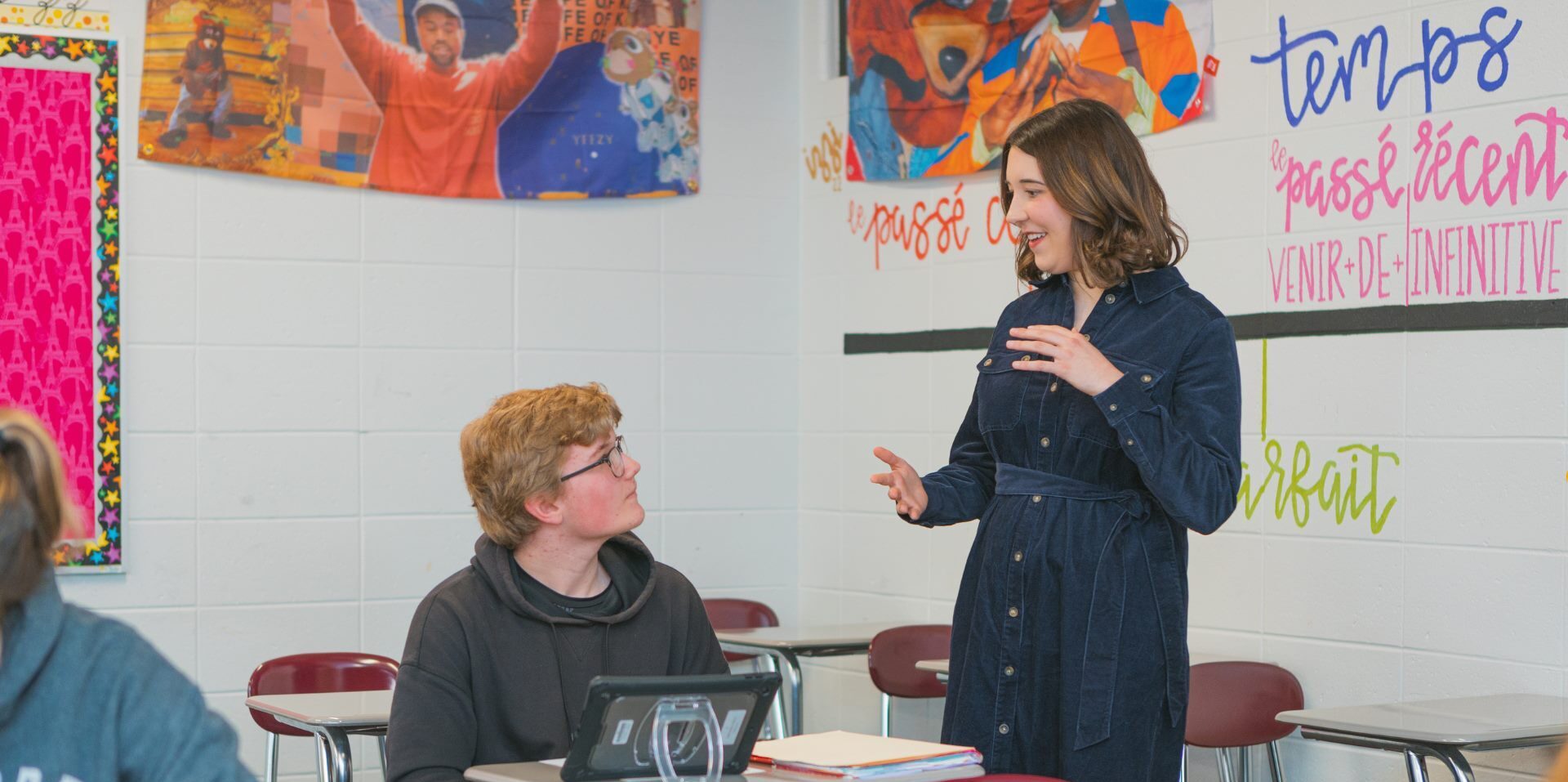
Terrazas teaches literacy in Spanish, not English, as part of a Dual Language Immersion program, and the science of reading looks a little different by language.
“In Spanish, we lean heavily into syllables, whereas English requires an earlier focus on individual sounds,” she said. Still, the foundation is the same either way: phonological awareness first, and then building toward literacy. “Every reading brain is the same,” she said. “It’s all about connecting those sounds to letters.”
In every challenge she faced, Terrazas found her professors very supportive. “They knew I was working and was a mom of two children,” she said.
She was always encouraged to do her best, and she saw professors go out of their way to help students succeed.
Beyond a bachelor’s degree, one of the Indiana teaching license requirements is to complete a state-approved educator preparation program, which includes student teaching.
Terrazas completed her student teaching in the very classroom where she’d already been working as a para, creating a smooth, practical transition rather than a jarring new placement.
“It was a very positive experience,” she said. She credits the dual feedback loop, her cooperating teacher, and her Grace professors with sharpening her skills quickly. Terrazas still references classwork and video examples from her courses regularly. One specific tool she still uses today is from her senior project: She learned how to build and administer a pre-assessment before starting a new unit. From there, she tracks student growth using the data.
“I actually did that just today,” she said. “I have to start teaching them everything that they’re going to see on the assessment. Giving them a pre-assessment lets me see what they know.”
When Terrazas decided to pursue her Indiana teaching license, cost was on her mind. Cost is a major roadblock for many teachers, but Grace makes it as accessible as possible.
“Grace was very supportive in helping to bring the cost down,” she said.
When a state teaching scholarship opened up with limited spots, she said, “I remember my professor the day that the scholarship opened up. She had all of us, her students, with our laptops ready to go, and all of our personal information filled out. All we had to do when the scholarship opened was click a button to submit the application.”
As a result of that preparation, Terrazas’ entire cohort got the scholarship. On top of that, she picked up a second scholarship tied to a high-need teaching area, the DLI program, which covered even more of the program.
Terrazas acknowledged that not everyone will be in the same boat as her when it comes to the cost of the program, but she is confident that Grace’s faculty will do their best to bring down the cost for any student as much as possible.
“I would definitely recommend Grace,” Terrazas said. “Not only do they have flexible professors, but they’re also very supportive. They are behind you 100% of the time academically and emotionally.”
Strong education matters, and Grace is here to help you become the teacher you dream to be. Before you get an Indiana teaching license, however, you have to have a passion for children and teaching.
“You have to have the heart to be around the children, because for many of them, school is their home,” Terrazas said. “Of course, there’s the educational part, but that’s why I went to Grace, and that’s where I got trained to do all the science of reading and all the other skills I use in the classroom.”
If you’re interested in getting your Indiana teaching license and becoming a teacher, the first step is to get in contact with us! Learn more from our Transition to Teaching director, Courtney Thrasher, or request information on our website.